

In an era where artificial intelligence is reshaping everything from jobs to warfare, governments worldwide are grappling with how—or whether—to rein it in. Some nations are pioneering thoughtful regulations to protect citizens, mitigate risks like bias and privacy invasions, and ensure AI serves the public good. Others are doubling down on unchecked growth, often at the behest of powerful corporations and oligarchs. This divide reveals much about who controls these countries: those prioritizing humanity or those fueled by corporate profits. Here’s a snapshot of the global landscape in early 2026, drawing from recent developments to enlighten those new to the conversation.
Pioneers in Responsible AI: Successes and Paths Forward
Several countries have made strides in taming AI’s wild side, focusing on risk-based frameworks that classify AI systems by their potential harm—low-risk tools like chatbots get light touch, while high-risk ones in hiring or healthcare face strict scrutiny.
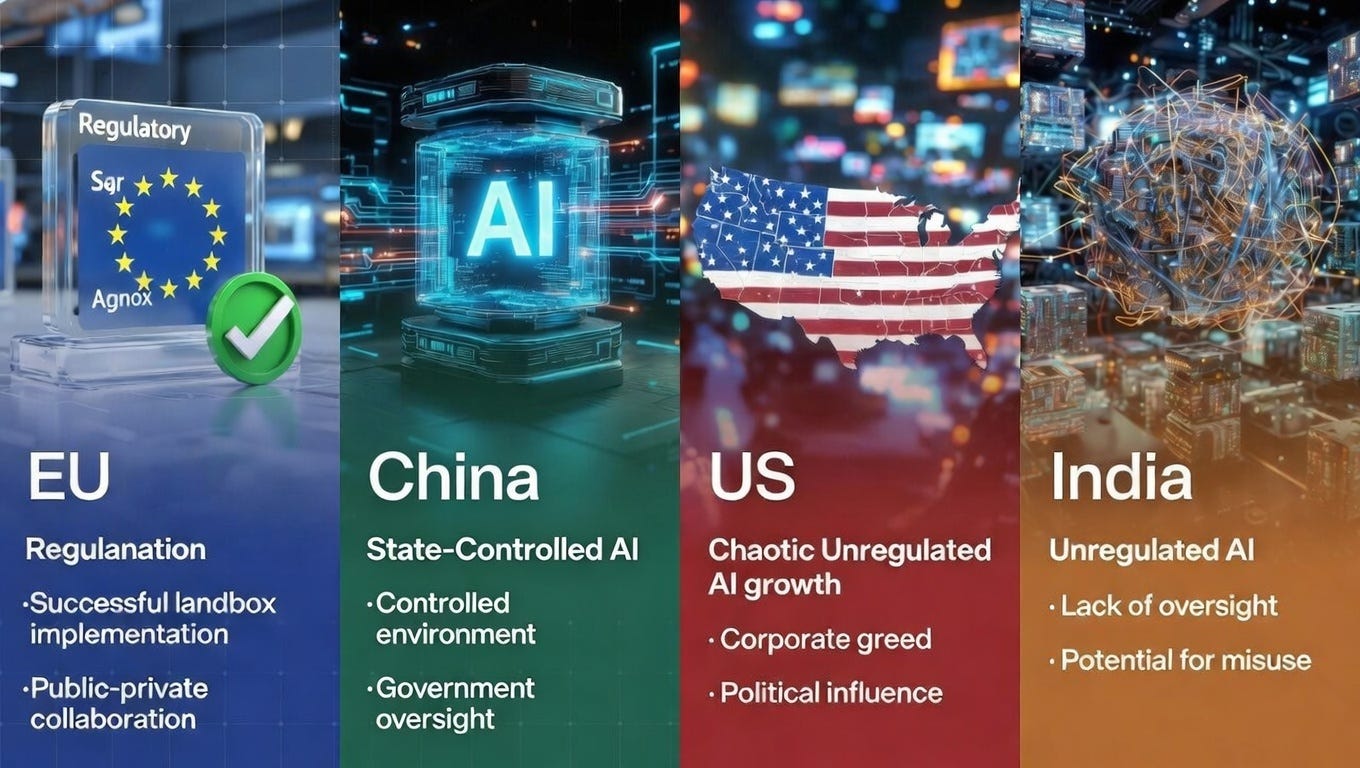
The European Union stands out as a trailblazer. The EU AI Act, fully rolling out by mid-2026, mandates transparency, bias testing, and human oversight for high-risk AI. It includes “regulatory sandboxes” for safe testing, helping startups innovate without breaking rules. Early signs show success: clearer policies have boosted adoption while curbing failures, with penalties up to 7% of global revenue enforcing compliance.
China has imposed some of the world’s toughest rules, requiring AI content to be labeled (e.g., deepfakes must disclose they’re synthetic) and algorithms to be accountable for societal impacts like mental health. This centralized approach has prevented chaos, though critics note it also aids state control.
South Korea’s Basic AI Act, effective this year, emphasizes transparency and safety in sectors like finance and education. Brazil’s new risk-based law mirrors the EU, targeting high-stakes uses to protect vulnerable groups. Japan opts for an innovation-friendly Promotion Act, coordinating government and industry without heavy burdens. Vietnam and Kazakhstan are following suit with similar frameworks set for 2026.
These efforts are succeeding because they balance innovation with safeguards, often through strong central coordination that clarifies rules and fosters trust.
What Works and What Doesn’t in AI Regulation
Effective strategies share key traits: Risk classification works by focusing resources on dangerous AI, like biased hiring tools, while letting low-risk ones flourish. Sandboxes and pilots allow real-world testing, reducing failure rates (historically 70-85% for AI projects). Central oversight bodies speed implementation and adapt to tech’s pace, as seen in the EU and China.
What doesn’t? Patchwork approaches, like the U.S.’s mix of state laws, create confusion and loopholes. Deregulation ignores risks—untested AI can amplify biases, erode jobs, or spread misinformation. Without labels or audits, “free” growth leads to scandals, as early internet history showed with data breaches and monopolies. Overly rigid rules can stifle startups, but flexible, principles-based ones (e.g., UK’s) avoid this.
Global coordination, like the UN’s push for unified standards, helps too—over 80 countries signed a 2026 AI safety pact. Yet, without it, “regulatory blocs” emerge, locking nations into region-specific AI stacks by 2027.
Champions of Unregulated Chaos: Profit Over People
On the flip side, some nations embrace AI’s “wild west” ethos, prioritizing economic gains over ethics. This often signals corporate capture, where tech oligarchs influence policy.
The United States, under President Trump, repealed Biden’s AI safeguards in 2025, arguing regulation hampers competition against China. Leaders like Sam Altman flipped from supporting oversight to opposing it. Initiatives like the $500 billion Project Stargate, backed by OpenAI and foreign investors, emphasize unchecked innovation. Federal moves preempt state rules, favoring Big Tech. Critics see this as greed-driven: Elon Musk’s DOGE gains access to government data, blurring lines between profit and public interest.
India focuses on attracting AI investments rather than strict rules, topping public sector adoption with Singapore and Saudi Arabia. These nations offer strong leadership support but lighter governance, risking inequality—AI could widen economic gaps if unchecked. The UK and U.S. declined a global “inclusive AI” declaration, citing security concerns.
The Bigger Picture: Humanity’s Fork in the Road
AI regulation isn’t just bureaucracy—it’s about who benefits from this tech revolution. Successful regulators like the EU and China show that thoughtful rules can harness AI for good, reducing harms and promoting equity. Unregulated paths, often in oligarch-influenced nations like the U.S., risk amplifying corporate power, job losses, and societal divides. As 2026 unfolds as a “compliance cliff,” watch which countries build for all versus a few. The choices reveal true priorities: humanity or greed? Stay informed; your future depends on it.
Focusing regulation on where the real harm lives instead of treating every AI tool the same makes sense. The problem is fragmentation. A state-by-state patchwork sounds flexible, but it usually turns into compliance confusion and loopholes. Great post!