


In an era where democratic governments like the United States and its Western allies proclaim a commitment to transparency and efficiency, the rapid expansion of “GovTech”—digital platforms for e-governance, blockchain-based systems, AI-driven public services, and smart city initiatives—tells a darker story. Far from being mere tools for modernization, these technologies are increasingly deployed as instruments of mass surveillance and social control, masking an authoritarian drift under the guise of public good. As governments grow more centralized and interventionist, GovTech projects funnel billions in taxpayer dollars into the hands of politically connected corporations through aggressive lobbying, lining the pockets of politicians while burdening citizens with higher costs and eroded freedoms.
This is not the stuff of dystopian fiction but a pattern observable in advanced economies, where the rhetoric of “innovation” and “accountability” conceals a symbiotic relationship between state power and corporate greed. Public anger over inefficiency or scandals is deftly redirected toward flashy digital solutions, which ultimately serve to expand government oversight rather than curb corruption.
The Dual Purpose: Efficiency as a Pretext for Control
At first glance, GovTech initiatives in countries like the US, UK, Canada, and Australia appear benign or even progressive. The US Digital Service, for instance, promises streamlined federal operations, while initiatives like the UK’s Government Digital Service or Australia’s Digital Transformation Agency tout user-friendly portals for everything from tax filing to healthcare access. Blockchain pilots for supply chain transparency and AI for predictive policing are hailed as breakthroughs.
However, beneath the surface, these systems are engineered for data aggregation on an unprecedented scale. In the US, programs like the FBI’s Next Generation Identification system or the Department of Homeland Security’s biometric databases collect vast troves of personal information—fingerprints, facial recognition data, and behavioral patterns—under the banner of security and efficiency. During the COVID-19 pandemic, contact-tracing apps rolled out by states like California and New York exemplified this: marketed as public health tools, they normalized location tracking and data sharing with authorities, setting precedents for ongoing surveillance.
As governments adopt more authoritarian styles—evident in expanded executive powers, crackdowns on dissent, and erosion of civil liberties—GovTech becomes a key enabler. Smart city projects in places like New York or Toronto integrate sensors, cameras, and IoT devices that monitor citizen movements in real-time, often without adequate oversight. In the UK, the National Health Service’s AI-driven patient data systems have raised alarms over privacy breaches, while Australia’s MyGov platform centralizes sensitive information, making it ripe for misuse in controlling access to services based on compliance.
These technologies don’t just “happen”; they are shaped by a feedback loop where governments justify expansions in the name of crises—be it terrorism, pandemics, or economic instability—while citizens are left with diminished privacy and autonomy.
The Corporate-Government Nexus: Lobbying, Contracts, and Kickbacks
GovTech’s failures aren’t accidental; they’re profitable. In the US, where lobbying expenditures by tech giants like Amazon, Google, and Microsoft exceed $50 million annually, government contracts for digital infrastructure are a goldmine. Amazon Web Services (AWS) alone secures billions through deals like the CIA’s $600 million cloud contract or the Pentagon’s JEDI project (initially valued at $10 billion), often amid allegations of favoritism and revolving-door hires between Silicon Valley and Washington.
This corruption is systemic: Corporations lobby for policies that mandate digital solutions, ensuring their proprietary technologies become embedded in public systems. In return, politicians benefit from campaign donations, stock options, and post-office board seats. For example, former US officials frequently join Big Tech firms, blurring lines between regulator and regulated. Similar patterns emerge in Europe, where companies like Palantir—founded by Peter Thiel and known for its surveillance software—secure lucrative contracts with governments like France and Germany for border control and policing AI, despite controversies over data ethics.
These “spot solutions” rarely address root inefficiencies because they’re awarded to insiders rather than through genuine competition. Overruns are common: The US’s Healthcare.gov launch in 2013 ballooned from $93 million to over $2 billion, plagued by contractor issues and minimal accountability. Yet, the real scandal is how these projects drain public funds—taxpayers foot the bill through higher taxes or diverted budgets—while delivering tools that enhance state control without true transparency.
Real-World Examples of Surveillance and Waste
• United States: The REAL ID Act’s digital identity framework, costing states billions since 2005, mandates biometric data collection for everyday activities like flying. It’s expanded surveillance capabilities, yet corruption scandals, such as lobbying by ID tech firms, highlight how funds enrich contractors like IDEMIA without reducing identity fraud.
• United Kingdom: The controversial NHSX app and data platforms, with costs exceeding £37 billion for digital health transformations, have been criticized for enabling government access to personal health records. Lobbying by firms like Google DeepMind has led to contracts amid privacy violations, fueling authoritarian oversight in public health.
• Canada: The Phoenix payroll system, a $2.2 billion debacle, failed spectacularly while collecting employee data. Meanwhile, AI border surveillance contracts with companies like Clearview AI—despite bans elsewhere—illustrate how GovTech prioritizes control over efficiency.
• Australia: The Robodebt scandal, where AI wrongly accused welfare recipients of debts, cost $1.8 billion in settlements. It exposed how automated systems, lobbied by consultancies like Accenture, serve to harass citizens while padding corporate profits.
Other Real-Word Patterns
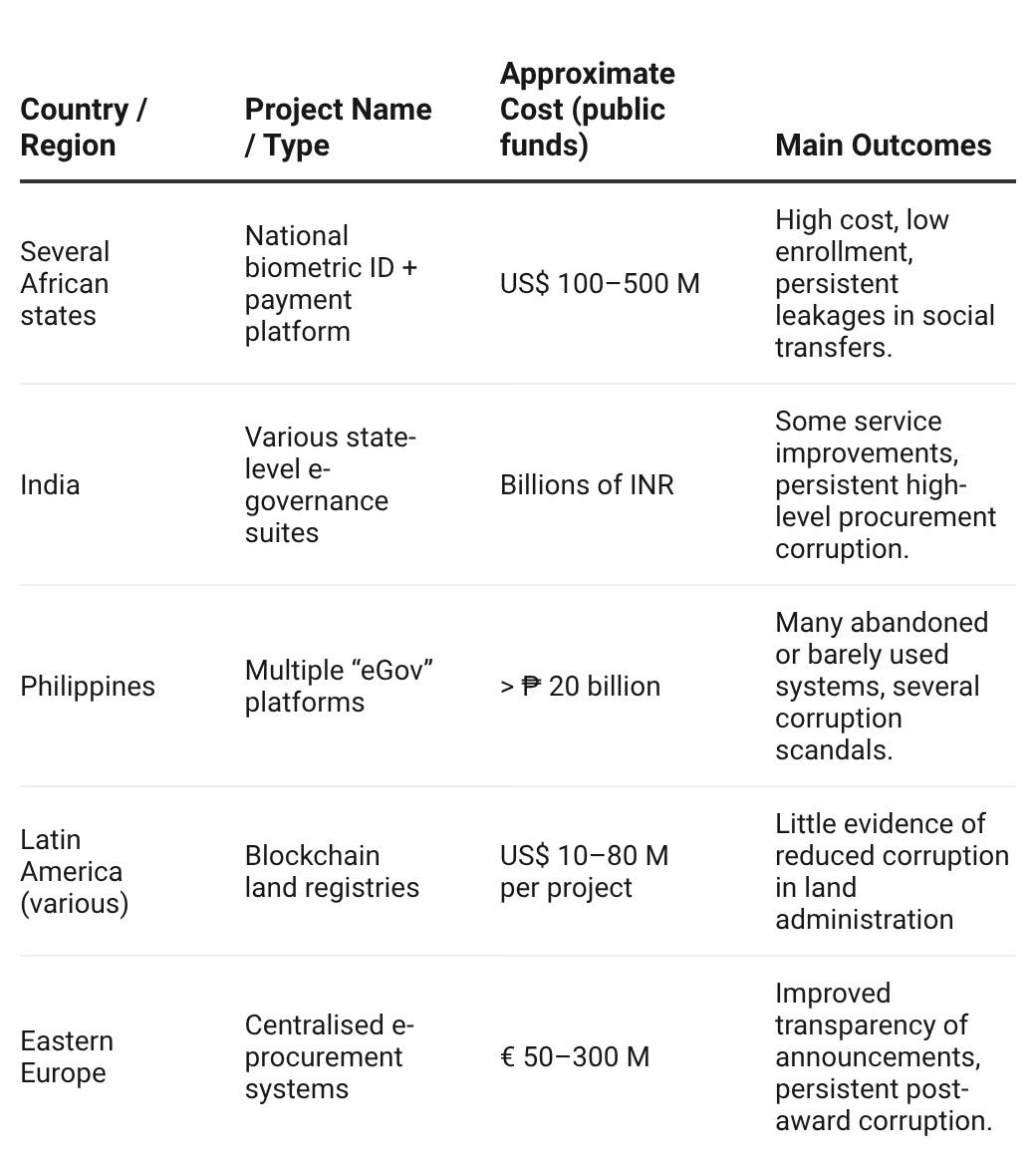
In each case, the authoritarian tilt is clear: Systems designed for “efficiency” end up policing behavior, from welfare compliance to protest monitoring, all while squandering funds on connected vendors.
The Burden on Citizens: Paying for Their Own Chains
Citizens bear the triple cost: financial, personal, and societal. Tax dollars fund these overpriced systems—US federal IT spending hit $100 billion in 2025 alone—diverting resources from essential services like education and infrastructure. Privacy erosion follows, as data harvested through GovTech feeds algorithms that profile and predict behavior, enabling preemptive control. Finally, the authoritarian creep undermines democracy: Dissenters can be flagged, services withheld, or movements suppressed under the veil of “data-driven governance.”
Politicians’ pockets are filled via indirect means—lobbying perks, super PAC contributions, and favorable regulations—ensuring the cycle continues. As governments like the US inch toward more centralized power, GovTech isn’t a fix; it’s a feature of this shift.
Toward Genuine Reform: Rejecting the Facade
To counter this, citizens must demand alternatives: Decentralized, open-source technologies that prioritize privacy over control; strict limits on corporate lobbying; and independent audits of GovTech projects. Strengthen whistleblower protections and data rights laws like GDPR, but enforce them rigorously.
In conclusion, GovTech in nations like the United States isn’t failing—it’s succeeding at its unspoken goals: bolstering surveillance, consolidating authoritarian control, and enriching a corrupt elite at public expense. Until voters dismantle this nexus, these digital tools will continue to forge chains, not freedoms, leaving citizens to pay the price for a system that watches them ever more closely.