

There are two pictures of Israel, and which one you carry depends on where you live.
In one, it is a democracy defending itself. In the other — the one most of the world is looking at — it is a government whose ministers have called for Gaza to be emptied, whose own intelligence officers describe a kill quota, whose military has killed nearly two hundred journalists, and which five separate bodies, two of them Israeli, have found to be committing genocide.
Same two years. Same events. Same footage.
The difference isn’t that one audience has more facts. It’s that Americans are shown a version assembled by people with a stake in which picture survives. Here is how that’s done — in dollar figures, editorial policies and dead reporters, all of it checkable.
What it costs an American politician to describe the second picture
Start with the money, because the money is public.
The Israeli government, through AIPAC and other channels, has spent the last five years making it expensive for an American politician to describe the second picture.
Until late 2021, AIPAC did not spend directly on elections. It wanted to be seen as neutral. Then it built a super PAC, the United Democracy Project, and started buying primaries.
2024. UDP spent about $9.9 million attacking Rep. Jamaal Bowman and another $4.8 million boosting his challenger. More than $14.5 million on a single House primary — the most any outside group had ever spent on a House race in American history. Bowman lost. UDP then put over $5.2 million into defeating Rep. Cori Bush. She lost too. They were the first two members of the Squad ever to lose a primary.
2026. AIPAC broke its own record. In Michigan’s Democratic Senate primary, UDP spent $30,638,639.63 — $20.14 million of it attacking Abdul El-Sayed directly, $10.5 million propping up Rep. Haley Stevens. Counting all outside money on Stevens’ side, the figure passed $54 million. El-Sayed raised roughly $14.5 million, almost all of it small-dollar, and was outspent by about eleven to one.
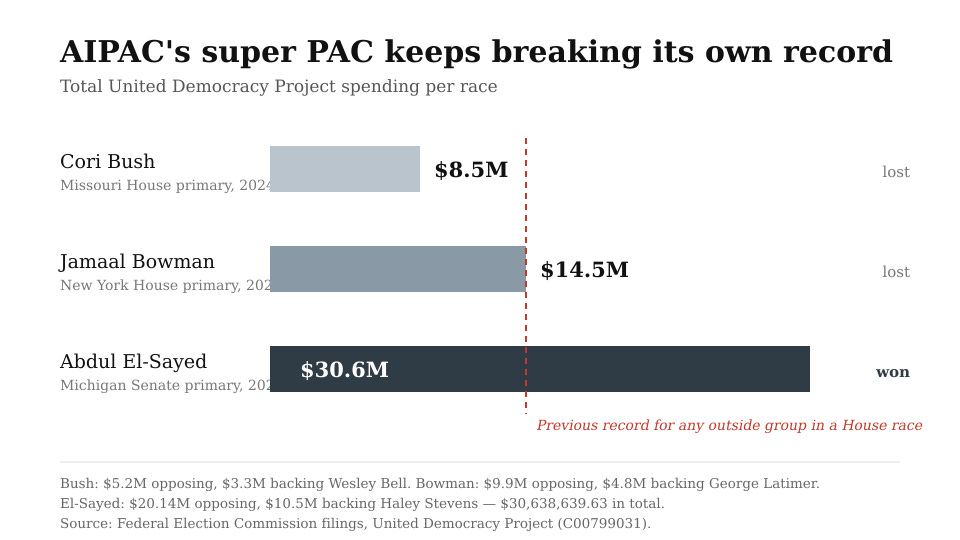
AIPAC has now spent more than $100 million on the 2026 midterms.
Notice what that money does not buy: a rebuttal. None of those ads argued that Israel isn’t doing what the UN Commission of Inquiry says it is. They talked about Michelle Obama. They talked about conspiracy theories. The actual subject never came up, because the actual subject isn’t winnable.
What it buys is a demonstration. Every member of Congress watched $14.5 million land on Bowman and $30 million land on El-Sayed. It doesn’t have to work every time. It only has to be expensive enough to think about before you speak.
That is why the second picture doesn’t reach American voters through their representatives. It’s been priced out.
Now here is the second picture, in their own words
Americans assume this part is murky. It isn’t. It’s on tape.
9 October 2023. Defense minister Yoav Gallant announces a total siege of Gaza — no electricity, no food, no fuel — and says they are fighting human animals. The next day he tells troops he has released all restraints. President Isaac Herzog says of Gaza that it is an entire nation out there that is responsible.
A defense minister. A head of state. On camera, speaking as the government. Law for Palestine has catalogued more than five hundred such statements since October 2023, each logged with the language it was said in.
That last detail is the argument. There are two records — one in Hebrew for home and the region, one in English for everyone else — and the gap between them is why an American can follow this closely and still not know what has been said about the people being bombed.
On 26 January 2024 the International Court of Justice read those statements into the record and ordered Israel, sixteen votes to one, to prevent and punish incitement to genocide by its own officials. A court instructed a state to stop its cabinet from inciting genocide.
Israel told the court the statements were random, out of context, or made by people without decision-making power.
The defense minister. The president. The energy minister.
Now ask when you last saw any of those quotes on an American broadcast.
The quiet part, said on Israeli television
On 12 August 2025, Netanyahu sat with Sharon Gal on i24NEWS. Gal handed him an amulet showing a map of the Promised Land and asked whether he subscribed to the vision of Greater Israel.
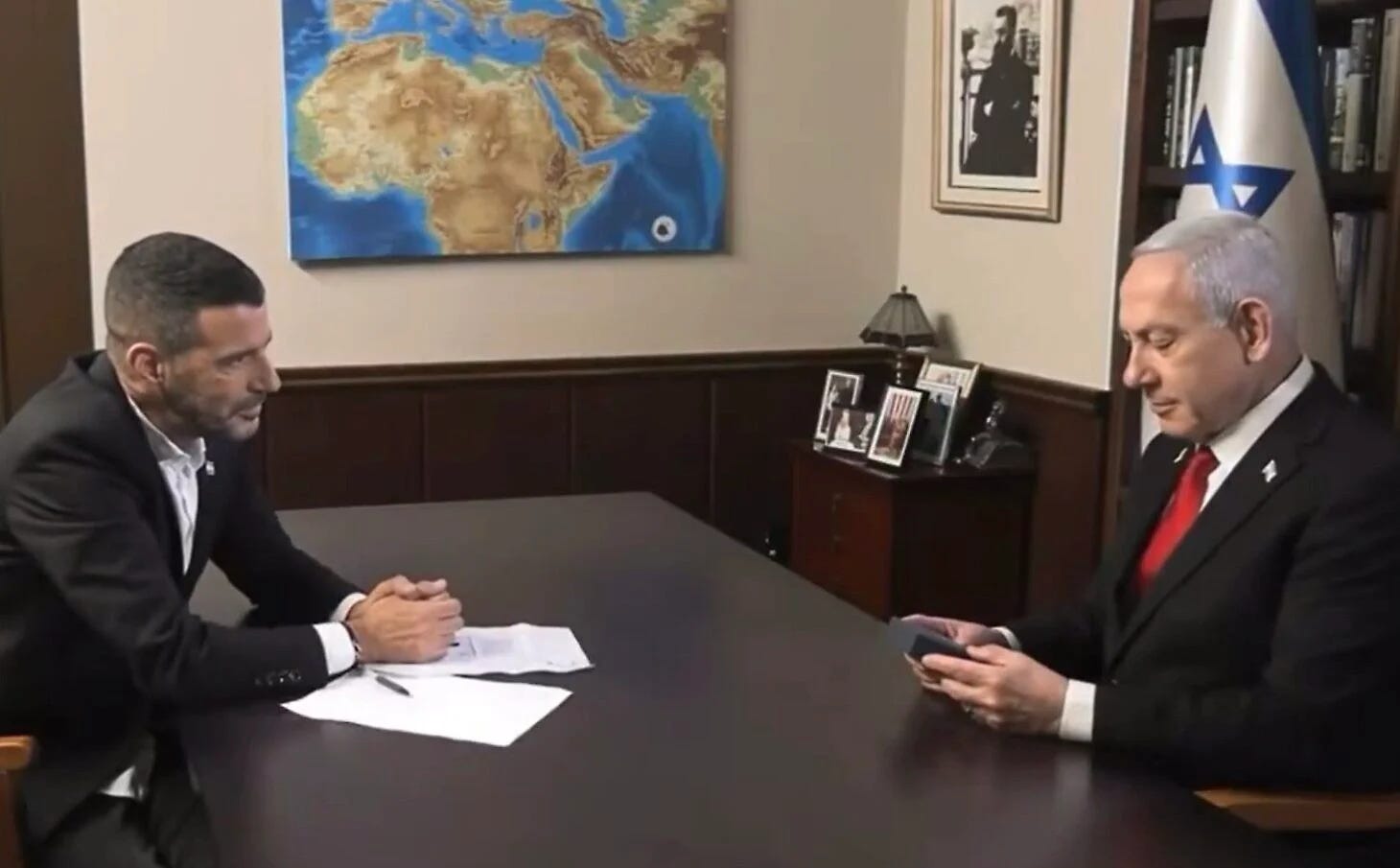
Netanyahu said: absolutely. Asked if he felt connected to it: very much. He called himself a man on a historic and spiritual mission, on a mission of generations.
“So if you’re asking if I have a sense of mission, historically and spiritually, the answer is yes.”
— Benjamin Netanyahu, i24NEWS, 12 August 2025
Greater Israel is a territorial claim running past the West Bank, Gaza and East Jerusalem into parts of Jordan, Lebanon, Syria and Egypt. Until that interview he had kept public distance from the phrase while the settlements expanded anyway.
In the same interview, on Gaza: we are not pushing them out, but we are allowing them to leave. The week before, his security cabinet had approved the plan to fully occupy Gaza City.
The region heard it immediately. Jordan called it a threat to the sovereignty of states. Saudi Arabia condemned it in the strongest terms. On 16 August, thirty-one Arab and Islamic governments, together with the Arab League, the OIC and the Gulf Cooperation Council, issued a joint condemnation.
Thirty-one governments responded to a sitting prime minister announcing a claim on their territory.
Now ask how much of that you saw.
That is the two pictures in a single week. He said it in the open. Americans were simply never shown it.
NAZA
The Israeli military has a word for the number of civilians an officer is permitted to kill in a strike. The word is naza. Collateral damage. It is said casually, as a quantity. We say fifteen naza.
That is the title of a documentary released this year by Yuval Abraham — the journalist who broke the Lavender investigation — and Rachel Szor, co-produced with the Guardian. Twenty-four Israeli intelligence officers and soldiers, many from the army’s most elite units, sit on Tel Aviv rooftops at night with their faces in darkness and describe what they did.
These are not conscripts repeating rumours. They are the people who built the target lists and signed off on how many civilians could die alongside each name.
They describe civilian deaths as a figure approved in advance, worked out from naza maps showing who was likely to be killed. They describe annihilation zones as policy, not accident — one says the objective was to destroy, another says the routine levelling of buildings simply wasn’t an issue. One chapter is titled Where’s Daddy?, after the system that tracked marked men and alerted operators when they entered their family homes. That was the preferred moment. At night, everyone inside. The film also alleges Israeli intelligence could access the cameras and microphones of Palestinian phones, including children’s.
“We say fifteen naza.”
— an Israeli intelligence officer, in NAZA (2026)
It corroborates what Abraham reported in April 2024 with +972 Magazine and Local Call, from six intelligence officers: a system called Lavender marked around 37,000 Palestinians as suspected militants, human review ran about twenty seconds per name — long enough to confirm the person was male — and it was known to be wrong roughly one time in ten. One officer called his job a stamp of approval.
Israel calls NAZA a manipulative depiction of reality. After it took the Special Jury Prize at Venice in September, the government promoted a counter-documentary, Naza: The Real Story, copying the rooftop format and asserting that Israel has the most moral army in the world. No Israeli cinema will screen the original. Abraham and Szor have left the country. Commentators at home called the film an act of treason.
Two films. Two pictures. One set of facts. One made by the soldiers who did it, the other by the government that ordered it.
And about that word: a military does not invent a term for the number of civilians you may kill unless it needs one short enough to say often.
The second mechanism: who was allowed to show you
The money shapes what politicians will say. Something else shapes what you see. These are separate systems — nobody at AIPAC edits a news broadcast — and they produce the same result.
They killed the witnesses. On 10 August 2025, Israel bombed a press tent outside al-Shifa hospital in Gaza City. Anas al-Sharif died. Mohammed Qreiqeh died. Ibrahim Zaher and Mohammed Noufal, who ran the cameras, died. Two freelancers died with them: Moamen Aliwa and Mohammad al-Khaldi. That brought Al Jazeera’s dead to ten staff and nine freelancers. Across the war the Committee to Protect Journalists counts more than 190 journalists and media workers killed — at least 184 of them Palestinians killed by Israel. More dead journalists than the entire world produced in the three years before this began, and the worst stretch for the press since CPJ started counting in 1992. CPJ’s regional director said Israel is murdering the messengers.
They barred the replacements. Foreign press has had no independent access to Gaza. American outlets covered a war in Gaza from Tel Aviv and Jerusalem.
They banned the broadcaster. May 2024: Israel’s cabinet voted to shut down Al Jazeera inside the country. The ban has been renewed again and again. The Ramallah bureau was raided.
And the outlets still standing had rules. January 2024: The Intercept reported that every CNN story touching Israel and Palestine had to clear the network’s Jerusalem bureau — a bureau operating under Israeli military censorship. CNN confirmed it and said the policy had been in place for years. The bureau chief expanded the review and named it Jerusalem SecondEyes. A staff member described what it meant in practice: war crime and genocide were taboo words. A Guardian investigation found senior staff refusing assignments to the region because they did not believe they would be free to report what they saw. In 2024, ten journalists who had covered the war for CNN and the BBC told Al Jazeera the same thing. Reporters have left or been pushed out of Western newsrooms over this coverage.
“war crime and genocide were taboo words”
— a CNN staff member, describing the network’s editorial policy to The Intercept, January 2024
That is not paranoia. It is a documented pattern with names, dates and a confirmed corporate policy.
Kill the people documenting it. Bar the ones who would replace them. Ban the broadcaster carrying it. Route whatever survives through a desk sitting under military censorship.
Then tell Americans the question is unsettled.
The findings came, late
Amnesty International, December 2024: genocide. B’Tselem and Physicians for Human Rights–Israel — both Israeli organisations, investigating their own government — July 2025: genocide. The International Association of Genocide Scholars, September 2025: genocide. And on 16 September 2025 the UN Commission of Inquiry, chaired by Navi Pillay, found Israel responsible for the commission of genocide in Gaza, and found it had flagrantly disregarded the court’s orders.
Nearly two years between a court reading those statements aloud and a UN body naming the crime. That is not slow by accident. That is the speed these institutions run at, and the record is consistent.
Srebrenica: July 1995, eight thousand men and boys. A tribunal called it genocide in 2004. Nine years.
Rwanda: 1994, eight hundred thousand people in a hundred days. The word arrived after the killing had already stopped on its own.
Both times the facts were available while it was happening. Reporters filed. Cables reached capitals. UN officers on the ground wrote it down and sent it up the chain. Nobody lacked evidence. What they lacked was a process that moved faster than the killing, and they still do.
A genocide finding is supposed to trigger prevention. Nine years late, it prevents nothing. It is an obituary with a legal citation attached.
And there is a new wrinkle worth naming, because it will matter more every year.
Ask one of the AI systems people now use for everything whether this is a genocide. You will get a careful answer. It will tell you the question is contested. It will cite the bodies that have ruled and note that others haven’t. It will decline to conclude.
That is not a glitch. These systems are built on text, and they are tuned to defer to institutional consensus — which means they inherit the lag exactly. They will acknowledge a genocide at roughly the moment a committee does, which is to say years after the people living it knew, and years after it could have mattered.
We have therefore built a machine that reproduces the delay and puts a reasonable voice on it. Hundreds of millions of people now ask these systems what is true. And on this, they are structurally incapable of answering faster than the institutions that have been late every single time.
So when someone tells you Gaza is still an open question, be precise about what is being asked of you. Not to wait for information — that has been public since October 2023. You are being asked to wait for a committee. And every committee in this history has spoken only after it stopped mattering.
The distance is the product
The money puts distance between what a politician knows and what a politician will say. The press controls put distance between the act and the public. The committees put distance between the crime and the judgment. None of it is accidental.
Everything above this paragraph is sourced and checkable. What follows is my own conclusion, and I want it labelled as such so nobody confuses it with a finding.
A government that announces a claim on its neighbours’ territory, empties a population while calling it permission to leave, automates a kill list reviewed twenty seconds per name, and kills nearly two hundred journalists to keep it off camera is not a democracy with a hard security problem. It is a terrorist entity — an entity using mass violence against civilians to achieve a political and territorial objective, which is the only definition of the word that has ever meant anything.
That is my judgment, not a tribunal’s. No body has issued that designation and I am not pretending one has. What I am saying is that if the word means anything at all, the test cannot be who the perpetrator’s allies happen to be.
Srebrenica and Rwanda were under-documented. This is the most recorded atrocity in human history, and the recording saved no one, because every system that mattered was built to put space between a decision and its consequence.
Anas al-Sharif was in that tent because he understood that. So were Mohammed Qreiqeh, Ibrahim Zaher, Mohammed Noufal, Moamen Aliwa and Mohammad al-Khaldi. The record exists because people stood inside it holding cameras until they were killed for doing it.
The least the rest of us can do is look at the picture they died making, and not wait nine years to say what is in it.
Sources and notes
ICJ, South Africa v. Israel, Order on Provisional Measures, 26 January 2024 — paragraphs 50–54 contain the quoted statements
Law for Palestine — database of 500+ documented statements
+972 Magazine / Local Call, Yuval Abraham, “Lavender: The AI machine directing Israel’s bombing spree in Gaza,” 3 April 2024 — 972mag.com/lavender-ai-israeli-army-gaza/
+972 Magazine / Local Call, Habsora investigation, November 2023
The Intercept, CNN Jerusalem bureau review policy, January 2024
The Guardian investigation into CNN editorial practice, 2024
Committee to Protect Journalists — cpj.org, journalist casualty data and the 10 August 2025 Al Jazeera strike
Amnesty International, You Feel Like You Are Subhuman, 5 December 2024
UN Independent International Commission of Inquiry report, 16 September 2025 — ohchr.org press release
B’Tselem and Physicians for Human Rights–Israel, July 2025